Will AI Replace Auditors in Malaysia? What Changes and What Remains With the Reviewer
AI can read documents, organize data and help an audit team find records that deserve attention. That can change how much time people spend on preparation. It does not, under the current audit framework, take over the auditor's responsibility to design the work, assess evidence and form the audit opinion.
That distinction matters more than a simple prediction about whether a profession will disappear. Some routine tasks may shrink or change. Firms may need different skills and controls. No one can promise that staffing patterns will remain the same. The practical question for a Malaysian audit firm is which work can the tool assist, and what must the engagement team still be able to explain and defend?
Which audit tasks can AI help with?
Depending on the tool and the firm's procedures, AI may help extract information from receipts and invoices, organize client documents, identify mismatches, suggest follow-up questions and prepare draft summaries. These outputs can make review more focused when they are linked to the underlying source and checked for errors.
The outputs are starting points. A parsed invoice field is not proof that the transaction occurred for the stated business purpose. A suggested exception is not a finding of fraud. A draft working paper is not, by itself, evidence that the required procedure was performed or that the conclusion is supported.
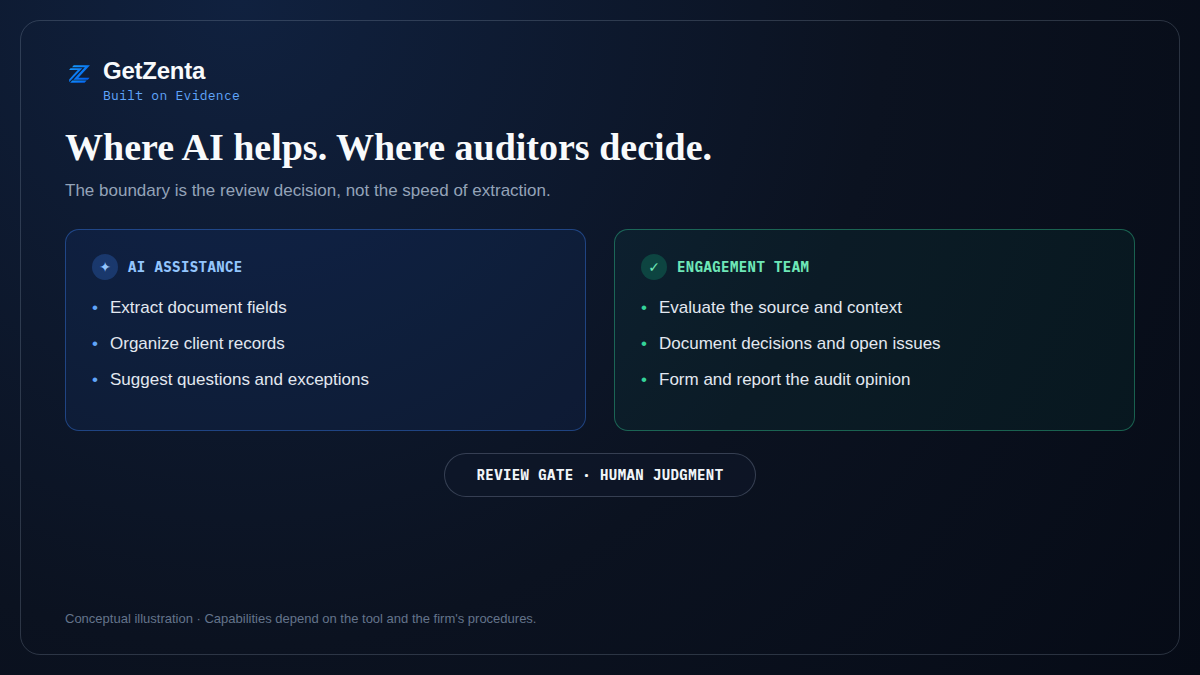
Illustration: examples of assisted tasks and the engagement team's review responsibilities; tool capabilities vary.
The IAASB's technology position supports appropriate use of technology to enhance audit quality while continuing to address the risks that new tools create. Its August 2026 proposals for ISA 330, ISA 500 and ISA 520 address technology and reinforce evaluation of the relevance and reliability of audit evidence. Those proposals are exposure drafts, not final requirements as of this article's preparation.
What remains the auditor's responsibility?
The engagement team must decide what information is needed, respond to assessed risks, evaluate what the evidence supports and document its reasoning. ISA 700 (Revised) concerns the auditor's responsibility to form an opinion and report on the financial statements. Software can assist the work behind that opinion; the software does not become the independent auditor.
Consider a fictional supplier invoice for RM4,800 described as “consulting services.” A tool extracts the amount, date and supplier correctly. The description still does not establish what service was delivered, who benefited or whether other support is needed for the relevant assertion. A reviewer may request the contract or work product, consider other available information, and record what remains unresolved. The next action depends on the engagement's circumstances and the auditor's professional judgment—not on the OCR confidence score.
This is why it helps to distinguish three records: the original source, the tool's output and the human review decision. If a model suggestion is corrected, a later reviewer should still be able to see what the model originally produced, who changed it, why, and whether the issue was actually resolved.
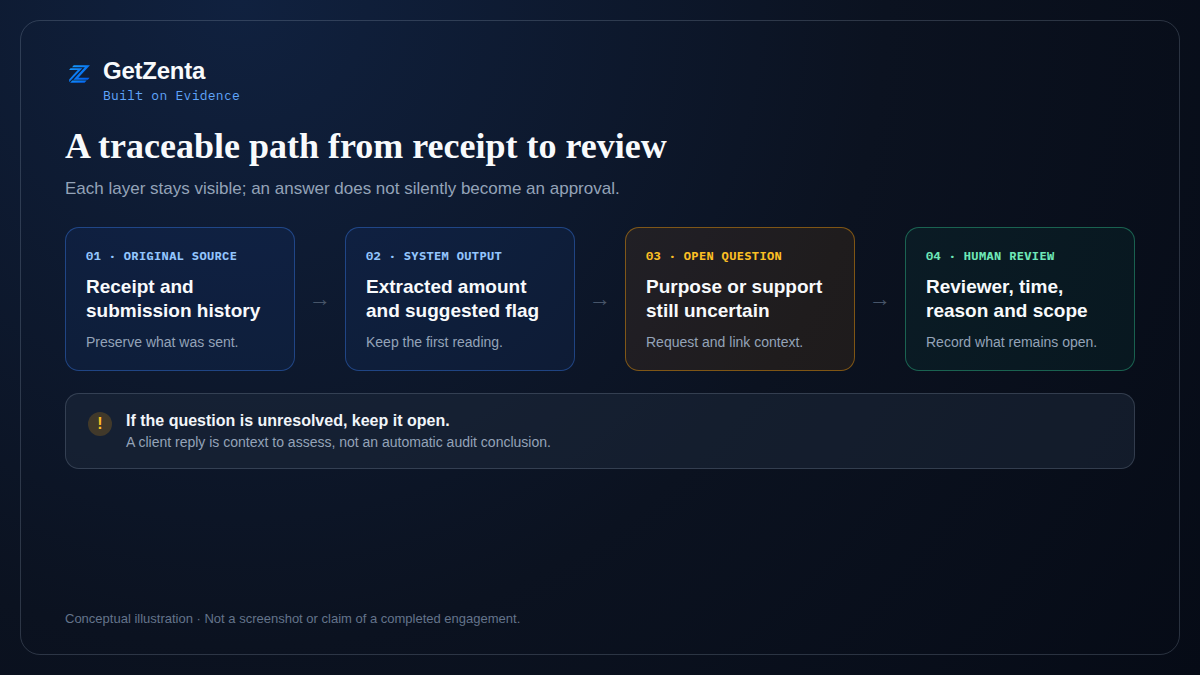
Illustration: an unanswered question stays open; a client response alone does not settle the audit conclusion.
Will AI reduce the need for people?
It may reduce time spent on repetitive preparation and change the skills a team needs. That is a real operational effect, not something to dismiss with “AI will never replace auditors.” But faster processing can also increase the number of outputs that need supervision. Firms must decide how to validate a tool, protect client information, investigate exceptions and train reviewers to challenge plausible but unsupported results.
The Malaysian Institute of Accountants' 2026 conference programme includes a session specifically on governing AI in audit, with professional judgment, accountability and oversight as its themes. That is a useful signal of the profession's current discussion; it is not evidence that a particular tool has been approved by MIA.
What should an audit firm ask when evaluating software?
If your firm searches for audit software in Malaysia or audit workpaper software, establish the product's actual scope first. A full engagement platform, a working-paper tool and a receipt-evidence workflow solve different parts of the job. Ask:
- Can a reviewer retrieve the original source and distinguish it from extracted or corrected fields?
- Which checks are deterministic, and which outputs are model suggestions? Can the team reproduce the result?
- Do missing, conflicting or higher-risk items remain visibly open until an authorized person assesses them?
- Are reviewer actions attributed, dated and supported by a reason, with the earlier state retained?
- What information can move into the existing working-paper process, and what integration is actually available today?
GetZenta focuses on receipt evidence and documented review, including the handoff from client submission to reviewer. It is not presented here as a replacement for an audit firm's entire planning, testing, reporting or working-paper system. The auditor remains responsible for deciding what the engagement evidence supports.
A better question than “Will AI replace auditors?”
Ask whether a tool lets the next reviewer trace the path from source, to question, to response, to decision—and see what is still open. AI can make parts of that path faster. Audit quality still depends on whether the team can evaluate the information and explain its conclusion.
For a concrete receipt-level example, see From Receipt to Reviewer: What Should Travel With an SME Transaction?. For the underlying control design, read Why Every AI Compliance System Needs a Human Accountability Layer.
Editorial note: This article explains general audit workflow concepts for Malaysian firms. The RM4,800 example and diagrams are illustrative. Firms should apply the standards and professional requirements in force for their engagements and evaluate any software against their own procedures. GetZenta does not issue audit opinions or determine tax deductibility or MyInvois acceptance.